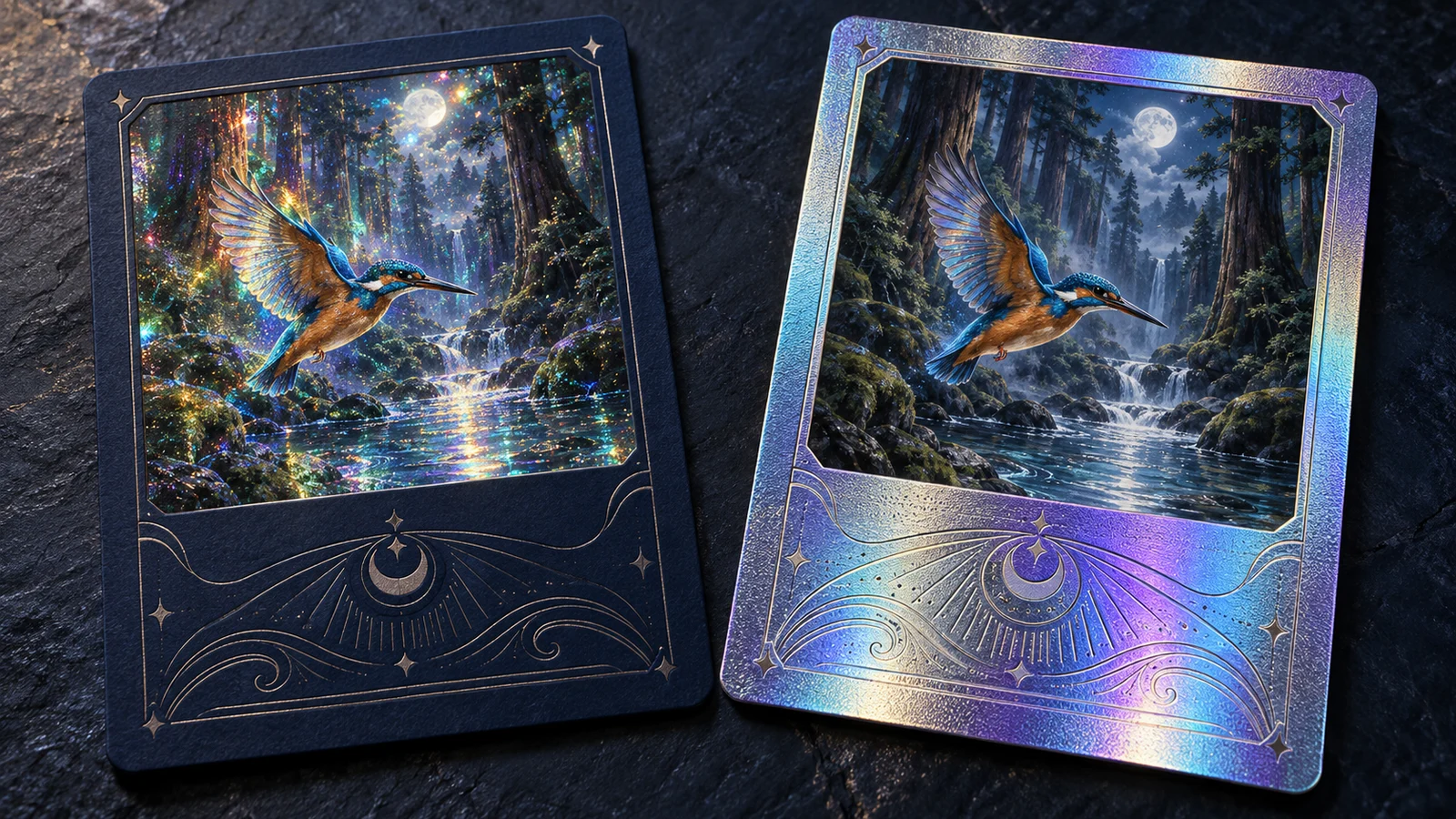
Tilt your card under a direct light and watch where the shine moves: the artwork, the frame and text box, or the whole card. Where the foil sits, and what pattern is pressed into it, tells you which version of the card you are holding, and each version has its own price.
Pokémon TCGPart of FoilFox’s multi-game guides · Also covering Magic, Lorcana & Star Wars
✨ Interactive 3D · Tilt cards under light
01 · Isolate the shine
Tilt the card slowly under a light and see whether the shine stays in the artwork box, covers the frame, or runs across the whole card.
02 · Inspect the pattern
Look closely at the foil for shapes pressed into it, such as Poké Balls, Energy symbols or cosmos circles, and run a fingertip over the card to feel for texture.
03 · Match set & number
Check the set symbol and collector number at the bottom of the card, because not every set was made with every foil version.
ℹ️
These are simplified drawings of where the foil usually sits. Foil strength, texture and borders vary between sets, languages and promos, so also check the set symbol and collector number on your card.
Finish · where the shine lives
Start with where the foil sits. A non-foil card has no holo layer, a holo shines in the artwork, a reverse holo shines on the frame while the artwork stays matte, and a textured full-art card carries foil across the whole face.
Non-foilNo holo layer
HoloFoil in the artwork
Reverse holoFoil on the frame and text box
Textured Full ArtTexture across the whole card
Pattern · what is stamped in the foil
A reverse holo can carry different patterns in the same place. A plain reverse, a Poké Ball reverse, a Master Ball reverse and an Energy reverse all shine on the frame, and only the shapes pressed into the foil change.
When you tilt a non-foil card, the artwork and text box reflect light evenly with no rainbow shine. Glossy card stock or a penny sleeve can still throw a plain white glare, and that glare is not foil.
Foil in the artwork
Holo
Foil in the artwork box
On a holo rare, the picture of the Pokémon carries the foil while the name, HP and attack text sit on plain card. If the picture is matte and the frame around it shines instead, you are holding a reverse holo.
Foil on the frame and text box
Reverse holo
Foil on the frame and text box, with matte artwork
A reverse holo is the foil version of a regular card, with the shine everywhere except the picture. Booster packs have included a reverse holo since Legendary Collection, so the same common can turn up in both the plain and the reverse version.
Reverse foil + Poké Ball stamps
Poké Ball pattern
One large Poké Ball, or rows of them, in the reverse foil
This is a second reverse holo version of the same card. Black Bolt and White Flare repeat rows of Poké Balls across the card, while Prismatic Evolutions and Ascended Heroes print one large ball behind the attack text. Japan’s Battle Region set used it first, in 2022. In English it first appeared on the basic Energy cards in Shrouded Fable packs, reached other cards with Prismatic Evolutions and returned in Black Bolt, White Flare and Ascended Heroes. In a set that never printed it, such as Destined Rivals, Poké Balls in the reverse foil of an Item card are part of the ordinary reverse holo.
Reverse foil + Master Ball stamps
Master Ball pattern
One large Master Ball, or rows of them, each with an M on the top half
In sets that have both ball patterns, the Master Ball version is much harder to pull than the Poké Ball one. In English that means Prismatic Evolutions, Black Bolt and White Flare; the English 151 set has no Master Ball reverse holos.
Reverse foil + Energy stamps
Energy symbol pattern
Energy symbols pressed into the reverse foil
Ascended Heroes gives its lower-rarity Pokémon cards two reverse holo versions. One carries Energy symbols matching the card’s type. The other carries a Team Rocket R on Team Rocket’s Pokémon, a Poké Ball on other trainers’ Pokémon such as Erika’s Oddish, and a Dusk, Friend, Love or Quick Ball on the rest, except Hoopa and Pecharunt, which carry a Poké Ball.
Cosmos pattern in the artwork
Cosmos holo
Dots and circles of different sizes in the artwork foil
Cosmos was the standard holo pattern from Base Set 2 through Call of Legends. Since the Black and White era replaced it, cosmos has been a common pattern for promo cards.
Texture across the whole card
Textured Full Art
A raised pattern you can feel across the card
In Scarlet and Violet sets, full-art Pokémon ex and Supporter cards and Special Illustration Rares have a texture pressed into the foil that you can feel with a fingertip. Some cards in the regular frame are textured too, so read the rarity symbol as well rather than relying on texture alone.
Cracked ice in the artwork
Cracked Ice holo
Angular shards, like broken glass, in the artwork foil
Since the Platinum era, cracked ice has marked special versions of cards, most often the featured Pokémon in a theme deck and promo cards sold in blister packs.
Confetti pattern in the artwork
Confetti / Sparkle holo
Small scattered flecks in the artwork foil
The 2021 McDonald’s 25th anniversary cards used this pattern. Every card in that promotion came in a non-holo and a confetti holo version, with one confetti holo in each pack.
Rainbow foil across the whole card
Rainbow Rare
Pastel rainbow foil over the whole card, with texture
Rainbow Rares are secret rares from the Sun and Moon and Sword and Shield eras, numbered after the main set. They reuse a full-art card’s artwork with rainbow foil in place of its normal colors, and the surface is textured.
Gold foil across the whole card
Gold Hyper Rare
Gold foil over the whole card, with texture
In Scarlet and Violet sets, Hyper Rares are textured gold cards marked with three gold stars and numbered after the main set.
What is the difference between a finish and a pattern?
Collectors describe a foil card by two things. The finish is where the foil sits, such as the artwork on a holo, the frame on a reverse holo, or the whole card on a textured full art. The pattern is the shape pressed into that foil, such as Poké Balls, Master Balls, Energy symbols or cosmos circles.
In Prismatic Evolutions, one Pokémon can come as a regular card, a reverse holo, a Poké Ball reverse holo and a Master Ball reverse holo. All four share a name, number and attacks but sell for different prices, so where the shine sits and what shapes are in it decide which one you are pricing.
How do other card games do foil?
Other games have their own foil versions. Magic: The Gathering has traditional foil, etched foil and textured foil. Disney Lorcana uses cold foil, where the foil is printed over the card rather than the card being printed on a foil sheet, so the shine can sit on only parts of the art. Star Wars: Unlimited has foil cards and Hyperspace foil cards, which pair the foil with an alternate frame that shows more of the artwork. In each game, tilting the card under a light is still the quickest way to see which version you have.